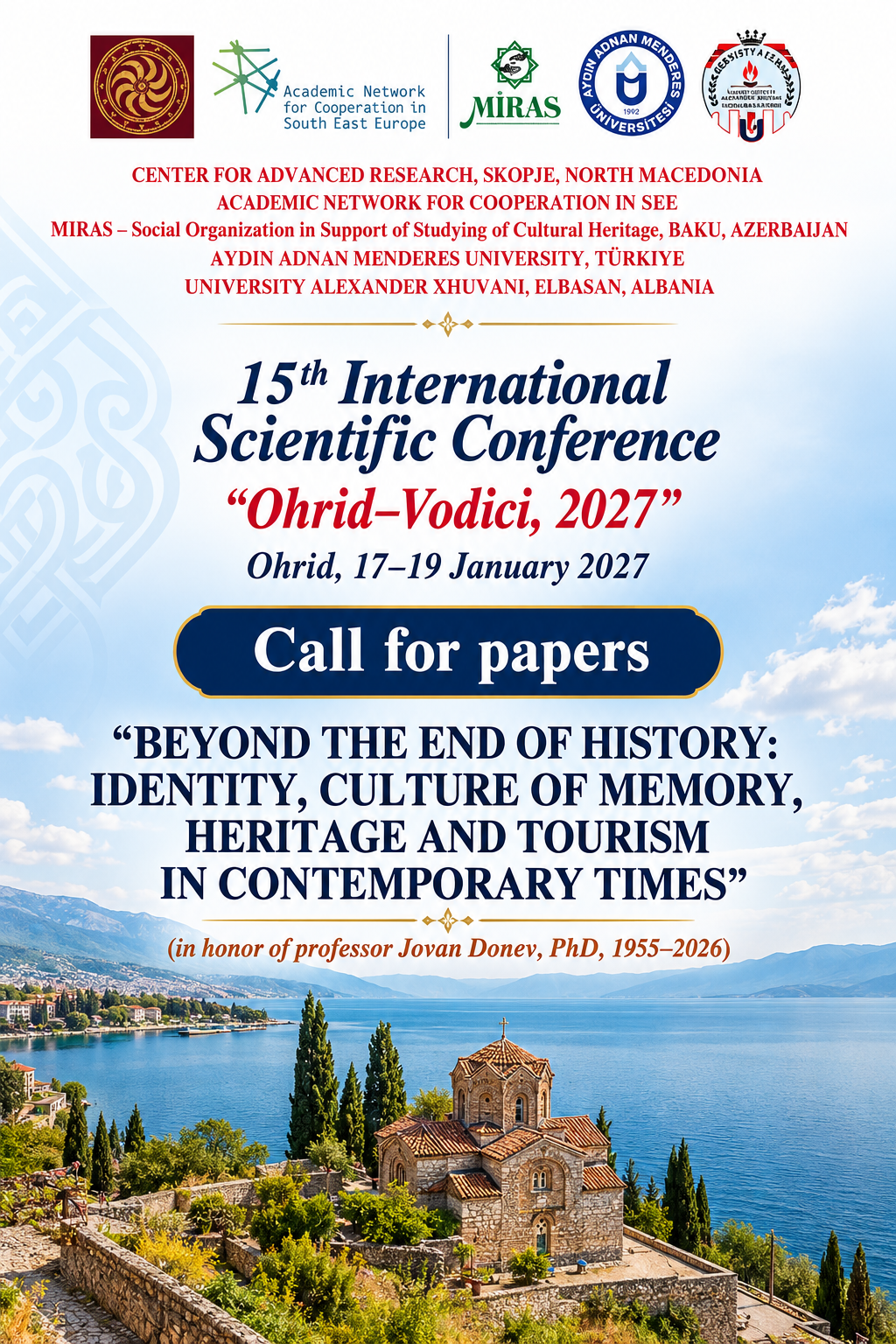
CENTER FOR ADVANCED RESEARCH, SKOPJE, NORTH MACEDONIA
ACADEMIC NETWORK FOR COOPERATION IN SEE
MIRAS- Social Organization in Support of Studying of Cultural Heritage, BAKU, AZERBAIJAN
AYDIN ADNAN MENDERES UNIVERSITY, TURIKYE
UNIVERSITY ALEXANDER XHUVANI, ELBASAN, ALBANIA
15th International Scientific Conference
“Ohrid -Vodici, 2027”
Ohrid, 17-19 January 2027
Call for papers
“BEYOND THE END OF HISTORY: IDENTITY, CULTURE OF MEMORY, HERITAGE AND TOURISM IN CONTEMPORARY TIMES”
(in honor of professor Jovan Donev, PhD, 1955-2026)
Conference Rationale
More than three decades after the end of the Cold War, the expectation that ideological conflicts, nationalism and competing historical narratives would gradually lose their political and social significance has been profoundly challenged. The famous thesis about the “end of history,” associated particularly with Francis Fukuyama and the post-1989 optimism surrounding liberal democracy and globalization, has been confronted by the return- or transformation - of geopolitical rivalries, wars, nationalism, identity politics, cultural polarization and competing interpretations of the past.
Contemporary societies appear increasingly shaped not by the disappearance of history, but by its powerful return to public, political and cultural life. Collective memories, historical traumas, myths, monuments, commemorations and competing narratives of belonging have become central elements in contemporary debates over identity, sovereignty, citizenship and cultural heritage.
At the same time, globalization, migration, digital communication, artificial intelligence and rapidly developing media environments are transforming the ways in which individuals and communities understand themselves and remember their past. Identities are increasingly multiple, fluid, transnational and digitally mediated, while simultaneously being challenged by movements seeking cultural homogeneity, historical continuity and clearly defined national, ethnic or religious boundaries.
Memory has consequently become an important arena of contemporary social and political contestation. Different groups compete over what should be remembered, forgotten, commemorated, preserved or presented as cultural heritage. Museums, monuments, archaeological sites, archives, religious buildings, landscapes and intangible cultural practices are no longer understood simply as remnants of the past. They function as active spaces in which contemporary identities are produced, negotiated and contested.
Heritage is also increasingly interconnected with tourism. Cultural and heritage tourism transforms historical places and memory sites into spaces of encounter between local communities, visitors and global narratives. Tourism may contribute to economic development, intercultural dialogue and the preservation of cultural heritage, but it can also produce commercialization, simplification and selective representations of complex histories.
The 15th International Scientific Conference “Ohrid-Vodici, 2027” invites scholars, researchers, PhD and MA students, cultural professionals, heritage specialists, tourism experts and policymakers to reconsider the relationship between history, identity, collective memory, cultural heritage and tourism in contemporary times.
Rather than asking whether history has “ended,” the conference proposes to investigate what comes beyond the idea of the End of History: the re-emergence of historical consciousness, memory conflicts, identity transformations and new forms of cultural and heritage production in an increasingly interconnected yet fragmented world.
Key Questions
The conference particularly welcomes contributions addressing questions such as: How has the post-Cold War understanding of history changed during the first decades of the twenty-first century? Why have identity and collective memory become increasingly important in contemporary societies? How are historical narratives reconstructed during periods of political, cultural and technological transformation? How do societies negotiate between remembering and forgetting? What role do monuments, museums, archaeological sites and intangible heritage play in contemporary identity formation? How are wars, migrations, borders and political transformations remembered across generations? How do digital technologies and artificial intelligence transform collective memory and cultural heritage? How does tourism reshape historical narratives and cultural landscapes? Can heritage tourism contribute to intercultural dialogue and reconciliation, and where does it instead reproduce stereotypes or competing narratives?
TOPICS OF INTEREST
Following the interdisciplinary approach of the previous conference—which welcomed scholars and practitioners from history, anthropology, sociology, heritage studies, political science, economics, tourism, psychology, media, architecture, museology, archival studies, archaeology, art history, geography and related disciplines - the 2027 conference welcomes theoretical, empirical and comparative contributions.
Submissions may address, but are not limited to:
1.Beyond the “End of History”: Contemporary Historical Transformations
1.The “End of History” thesis reconsidered
2.Post-Cold War transformations and new geopolitical realities
3.Globalization, fragmentation and the return of history
4.Nationalism, post-nationalism and transnational identities
5.Democracy, identity and contemporary social transformations
2.Identity in Contemporary Times
1.National, ethnic, religious and cultural identities
2.Multiple, hybrid and fluid identities
3.Minorities and identity politics
4.Migration, diaspora and transnational belonging
5.Globalization and local identities
6.Identity in multicultural and intercultural societies
7.Generational transformations of identity
3.Culture of Memory and Memory Politics
1.Collective and cultural memory
2.Politics of remembrance and forgetting
3.Contested memories and competing historical narratives
4.Memory of wars, conflicts and political transitions
5.Post-socialist and post-communist memory
6.Post-conflict societies and reconciliation
7.Trauma, victimhood and memorialization
8.Monuments, commemorations and public memory
9.Intergenerational transmission of memory
4.Cultural Heritage and Contemporary Society
1.Tangible and intangible cultural heritage
2.Heritage, identity and belonging
3.Archaeological heritage and contemporary identities
4.Museums, archives and heritage institutions
5.Contested and dissonant heritage
6.Heritage preservation and cultural sustainability
7.Heritage of minorities and marginalized communities
8.Religious heritage and sacred landscapes
9.UNESCO heritage and local communities
5.Heritage, Memory and Tourism
1.Cultural and heritage tourism
2.Memory tourism and places of remembrance
3.Dark tourism and traumatic heritage
4.Religious and pilgrimage tourism
5.Archaeological tourism
6.Tourism and local identity
7.Authenticity and commercialization of heritage
8.Tourism, cultural sustainability and local development
9.Heritage routes and transnational cultural itineraries
6.Digital Memory, Heritage and Artificial Intelligence
1.Digital archives and museums
2.Social media and collective memory
3.Artificial intelligence and representations of the past
4.Digital reconstruction of lost or endangered heritage
5.Virtual and augmented reality in cultural tourism
6.Digital storytelling and cultural identities
7.Misinformation, historical revisionism and digital memory
8.Ethics of AI in heritage and memory studies
7.The Balkans, Europe and the Mediterranean in Contemporary Memory
1.Post-Yugoslav memory and cultural heritage
2.Ottoman, Habsburg, Byzantine and socialist legacies
3.Memory, borders and migration in Southeast Europe
4.Shared and contested Balkan heritage
5.Mediterranean identities and cultural encounters
6.East-West/Orient-Occident narratives
7.Transnational and intercultural memories
8.Heritage as a bridge between communities
8.Theoretical and Methodological Perspectives
1.New approaches to memory studies
2.Anthropology of memory and heritage
3.Heritage studies and critical heritage theory
4.Oral history and life histories
5.Digital humanities
6.Comparative and transnational approaches
7.Interdisciplinary methodologies for studying identity, memory, heritage and tourism
IMPORTANT DATES
Deadline for applications: 1 December 2026
Notification of acceptance: 19 December 2026
Registration deadline: 9 January 2027
Conference: 17-19 January 2027
Submission of Abstracts, Poster Proposals, and Panel Proposals
The conference is open to individual paper submissions, poster presentations, and proposals for thematic panels.
Applications should include:
• Title of the paper or poster;
• Abstract in English of no more than 300 words, clearly indicating the principal argument, methodology and expected conclusions;
• Panel proposals of no more than 300 words, accompanied by abstracts of the individual panel papers;
• Name, academic title and institutional affiliation of the author(s);
• Short biography of the author(s), not exceeding one paragraph;
• E-mail address and contact details;
• Posters should be 50 × 75 cm.
This retains the main submission format used for the 2027 conference.
CONFERENCE LANGUAGES
The official conference languages are English and Macedonian.
VENUE
The Conference will be held in Ohrid, Republic of North Macedonia, at the premises of the Macedonian Academy of Sciences and Arts - House of Uranija, University St. Paul the Apostle and Museum of Ohrid.
The conference will begin on 17 January 2027 and conclude on 19 January 2027.
PARTICIPATION AND PUBLICATION
All registered participants will receive a Certificate of Attendance.
All accepted abstracts will be published online in the Conference Book of Abstracts.
Selected papers presented at the Conference will be considered for publication following a double-blind peer-review process. The 2026 Call specifies that the conference proceedings are registered in CEEOL and thereby disseminated through discovery systems including Google Scholar, ProQuest/Summon, Primo Central, Alma, EBSCO EDS, TDNet and OCLC; this wording can be retained for 2027 once the same publication arrangement is confirmed.
REGISTRATION
Participation fee: EUR 100
The participation fee includes registration, conference materials, welcome reception, refreshments and certificate.
Accommodation and travel expenses will be covered by participants. The Organizing Committee may assist participants by recommending suitable accommodation in Ohrid.
ACCOMMODATION
The participants will cover accommodation costs. Organizing committee may facilitate or propose proper accommodation.
TRAVEL
Participants will be responsible for paying their travel expenses.
CONTACTS
conference.vodici2027@gmail.com
Contact person:
Gordana Angelicin Zhura PhD ( gordanazhura@gmail.com), viber +389 72316616
Marina Vrvcoska MA (marina.vrvcoska@gmail.com), viber: + 38970422287
THE CONFERENCE SCIENCE AND PROGRAMME COMMITTEE
Rubin Zemon, Ph.D. Centre for Advanced Research, Skopje, North Macedonia
Goran Basic, Ph.D., Academic Network for Cooperation in SEE, Belgrade, Serbia
Fariz Khalili, Ph.D. MIRAS Social Organization in Support of Studying of Cultural Heritage, Baku, Azerbaijan
Ahmet Aytac, Ph.D. Aydin Adnan Menderes University, Izmir, Turkiye
Veselin Popov Ph.D., Institute of Ethnology and Social Anthropology of the Slovak Academy of Science
Elena Marushiakova Ph.D.. Honorable Professor of the University St. Andrews, Scotland United Kingdom
Veronica Wittman Ph.D., Johan Kepler University, Linz, Austria
Jody Jensen Ph.D., Institute for Advanced Studies, Koszeg, Hungary
Selma Muhic Dizdarevic, Charles University, Prague, Czechia
Ardian Lami Ph.D., University Alexander Xhuvani, Elbasan, Albania
Meli Shopi, Ph.D., University Alexander Xhuvani, Elbasan, Albania
Juraj Marushiak Ph.D., Institute of Political Science, Slovak Academy of Sciences
Petko Hristov Ph.D., Bulgarian Academy of Science, Institute of Ethnology and Folklore Studies with Ethnographic Museum, Sofia, Bulgaria
Mutluhan Taş Ph.D., Gazi University, Ankara, Turkiye
Milica Jokovic Pantelic Ph.D., Institute for Social Sciences, Belgrade, Serbia
Ahmed Alibasic Ph.D., University of Sarajevo, Bosnia and Herzegovina
Dejan Metodijeski, Ph.D. University Goce Delchev, Stip, Skopje, North Macedonia
Mustafa Ibraimi Ph.D., Univesity Mother Theresa, Skopje, North Macedonia
Kubilay Akman, Ph.D., Usak University, Usak, Turkiye
Jasminka Simić, Ph.D. Editor- in - chief, Radio-Television of Serbia, Belgrade, Serbia
Valbona Kalemi Ph.D., Albanian University, Tirana, Albania
Organization Committee
Gordana Angelicin Zhura, Ph.D. , Center for Advanced Research, Skopje
Igor Panev M.A., University Ss Cyril and Methodius, Skopje.
Fatima Salifoska Ph.D., Institute for Spiritual and Cultural Heritage of Albanians, Skopje
Zoran R. Vitorovic, DID Ph.D, Center for Advanced Researches, Skopje
Marina Vrvcoska M.A., Center for Advanced Research, Skopje
Denada Cipi, PhD. Candidate, University Alexander Xhuvani, Elbasan, Albania
Rudina Hoxha PhD. Candidate, University Alexander Xhuvani, Elbasan, Albania
Liljana Paneva, Center for Advanced Research, Skopje
|


 Twitter
 Google
 Myspace


